Scottish Mortgage 2026 Forum: The Golden Age of Change
Claire Shaw – Portfolio Director
- A Golden Age of Change: why AI marks a new paradigm shift and reshapes long-term growth investing
- From digital assistants to autonomous trucks: where value is emerging and where it scales next
- China, platforms and patience: seeking outlier returns more broadly, amid global technological change

As with any investment, your capital is at risk.
At Scottish Mortgage’s early 2026 forum for professional investors, managers Tom Slater and Lawrence Burns argued we are entering a “Golden Age of Change” – a period of intense innovation that could “dwarf the advances we have seen over the past two decades”.
AI Creates an Intelligence Paradigm
Slater borrowed NVIDIA CEO Jensen Huang’s surfing metaphor: companies can’t ride a wave by resisting; they must “feel where it’s going and go with it.”
The work starts early – “begin paddling long before the AI wave hits” – and then requires full commitment when momentum arrives.
The “most dangerous point of surfing is the drop”, when you transition from paddling to standing. That means, once companies have product-market fit, dropping what they were doing from a legacy perspective and going all in to deliver that product and meet demand.
He said a conversation with Spotify co CEO Alex Nordström captured the shift in mindset: what firms need now is “anticipation”. Slater agreed that the last decade rewarded extrapolation, but “today, we’re back to this point of needing to anticipate.”
He framed intelligence as the next paradigm shift, replacing the internet-mobile-cloud era, which created the “giant network companies that dominate the global economy today”.
“For us, as long-term growth investors, what’s exciting about this is that when you get these shifts, it gives rise to new large companies, new growth opportunities, because the paradigm determines where value accrues within the ecosystem.”
So far, he said, “most of the value has amassed at the silicon chip layer, and mostly at NVIDIA.” That is likely to persist while compute remains scarce, “we still will need a lot more silicon.”
Slater pointed to personal assistant chatbots and coding assistants as the two applications that have emerged so far. “OpenAI’s ChatGPT is in the top five most visited websites in the world… and that’s why OpenAI is worth $500bn today.”
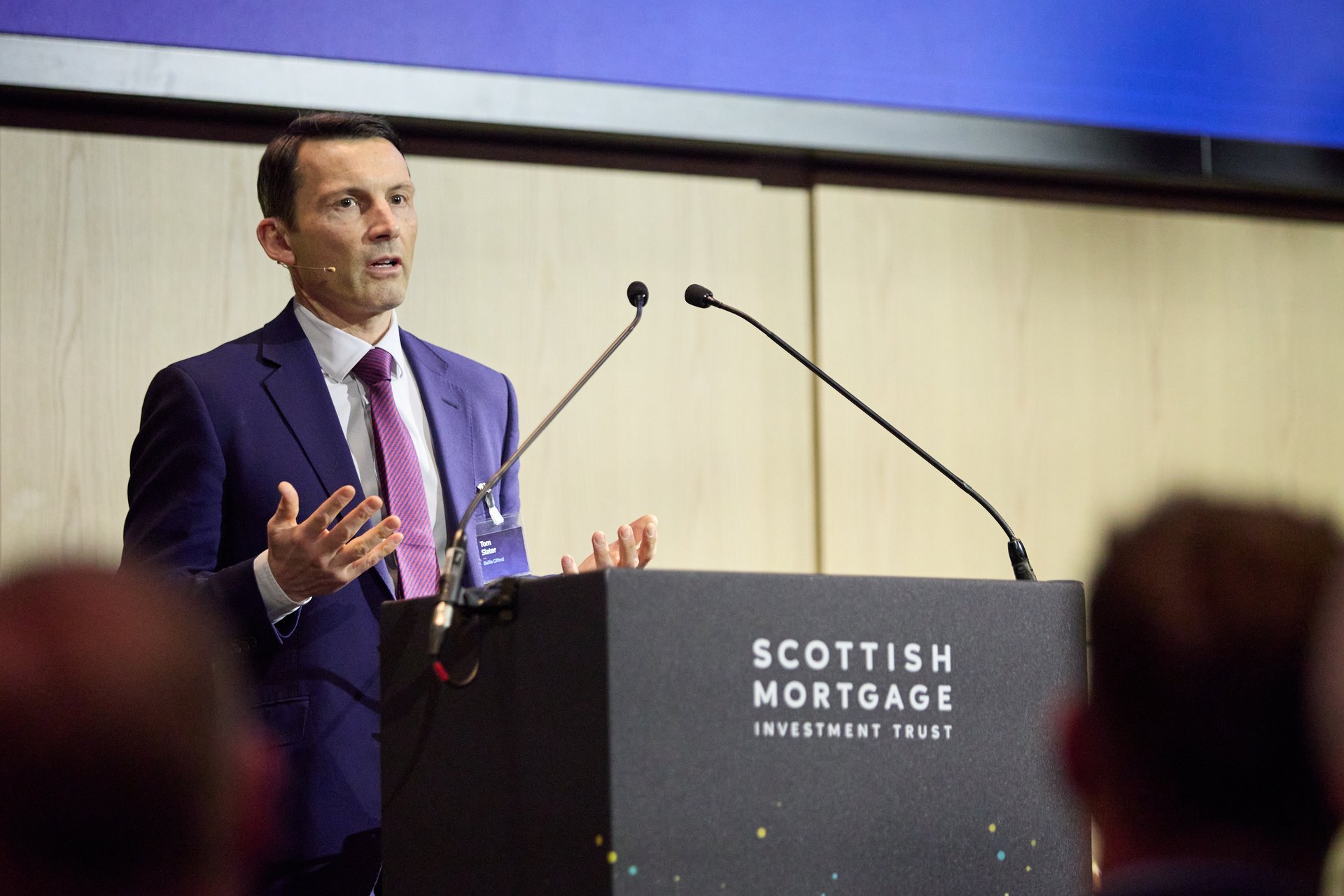
Coding, he said, is “the beating heart of the modern economy” but also “the biggest constraint to growth” given the shortage of engineers. But he said that Scottish Mortgage holding Anthropic has passed the drop and is already surfing as one of the fastest-growing technology companies of all time, compounding its revenues at about 10 times per annum.
As AI moves from software into “embodied intelligence”, Slater expects “even more profound winner-takes-all or winner-takes-most economics,” because only a small number of firms can fund the race.
He predicted the path would look gradual until it suddenly isn’t, shifting from the progress seen in the internet-mobile-cloud paradigm to sudden equivalence in the intelligence paradigm, where there will be a “dramatic swing”.
Within embodied intelligence – where AI is integrated into physical systems, enabling interaction with the physical world – autonomous trucking is nearing that threshold.
Progress to here has been slow as safety is non-negotiable: “If you are going to take a 36-ton juggernaut travelling at 60 miles an hour and take the driver out of it and replace him with a computer, you have to be sure that that thing is going to be safe.” But things are changing, and Slater highlighted how holding Aurora has successfully positioned itself to benefit as autonomy scales.
In logistics, he made the same point about speed and consumer behaviour. With Zipline, “if you change that hour [delivery window] into 15 minutes, then you change consumer behaviour” – and “there aren’t enough humans to do that, so this [55 billion deliveries a year] will be a drone market.”
China, Platforms and Outlier Returns
Burns began with his recent trip to China. Sentiment has shifted sharply, he said, but “far less has changed on the ground.” China “remains a place that produces visionary entrepreneurs” and where technologies can be rolled out “at extraordinary speed and scale”.
In batteries, he noted that “85 per cent of global battery cell production is in China,” and that Scottish Mortgage holds CATL, which “accounts for roughly 40 per cent of the global market share.” He sees a “multi-decade opportunity” as the platform expands beyond EVs, including into grid storage.
In electric vehicles, he described BYD as “the clear global leader accounting for roughly one in four electric vehicles that are sold worldwide.” After meeting BYD’s founder, Burns relayed a message that went beyond cost: “it’s not just that we’re producing cheap cars profitability, but we’re producing much better cars.”
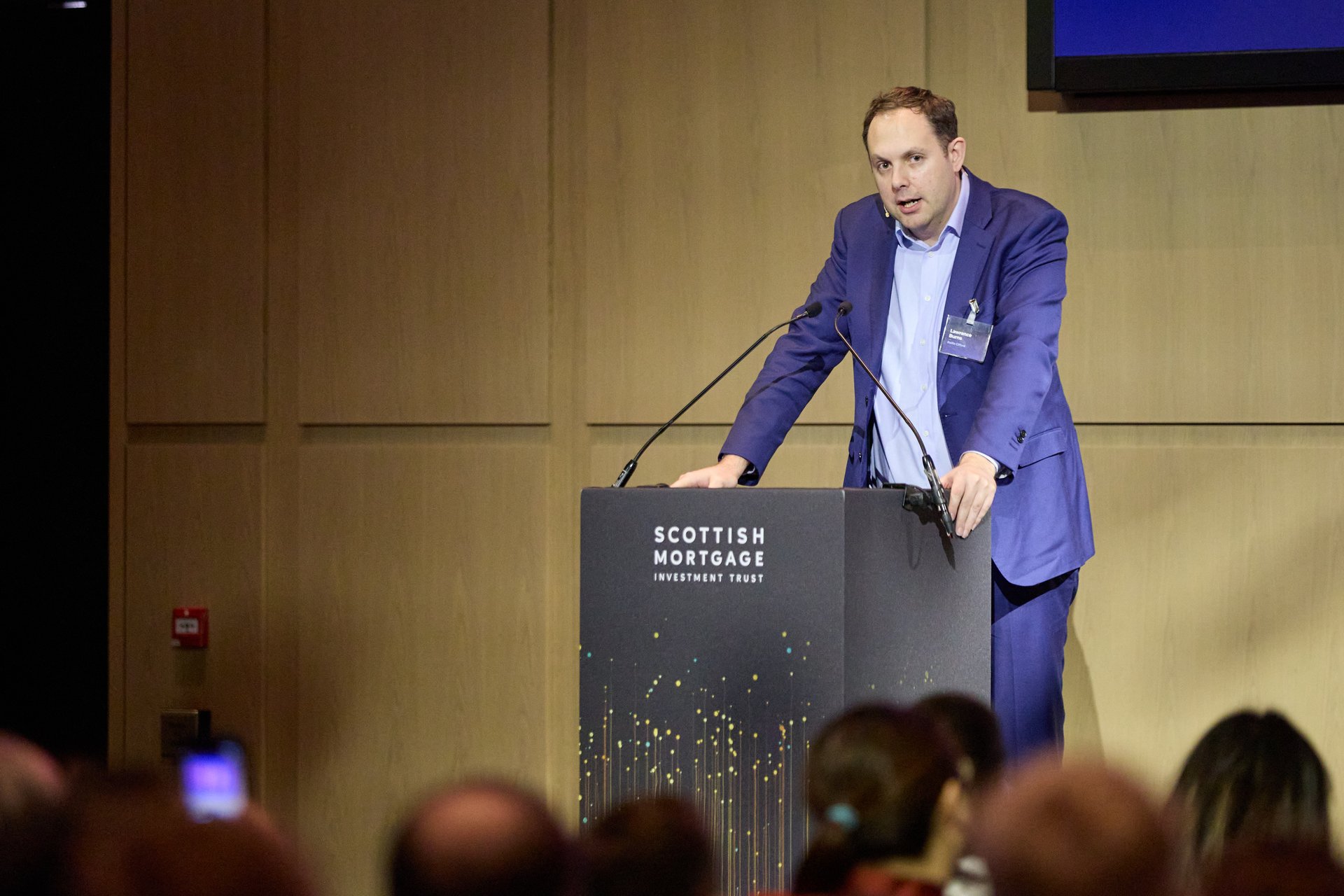
He was candid on the risks: “Geopolitical risk is real. Domestic regulatory risk is real.” Reflecting that, he said Chinese exposure has fallen from about 24 per cent at the end of 2020 to around 12.5 per cent currently. Even so, he argued there are still “opportunities for a small number of exceptional companies in China.”
In those cases, “tech and growth remain very much discounted and on sale.” He also noted the market’s pricing of geopolitical risk can be uneven: if there were a genuine economic schism, companies with deep operational and revenue links to China would likely be affected far more than current valuations imply.
And, he added, “understanding China has never been more important than it is today,” alongside Silicon Valley, in tracking how technology is evolving.
Burns then turned to platform businesses. Most firms operate as “a linear value chain,” he said, creating value by selling products and/or services to consumers; platforms are different. They “create value by facilitating transactions between two participants and sometimes more. They orchestrate ecosystems, set rules, provide shared infrastructure and align incentives so others can create value.”
“As platforms scale, they tend to get better.” Scale strengthens network effects, improves data and recommendations, and lets the largest platforms amortise infrastructure across millions of participants. They are also “highly adaptable”, and the biggest can deliver “second, third, or even fourth acts”.
Owning them, Burns concluded, requires a particular mindset: “You need imagination. A willingness to analyse not just what does exist, but what could exist. And you also need patience… the financial profiles can look very unappealing and then suddenly inflect and become very positive when they turn that monetisation on.”
Q&A and Closing Note
In Q&A, Burns reiterated that the portfolio is built bottom-up, while trying to avoid “blind spots” in future-relevant regions.
Slater pointed to Shopify’s adaptability as commerce channels evolve, and he updated on SpaceX and its subsidiary Starlink, considering the opportunity ahead and the acquisition of EchoStar’s spectrum licences for direct-to-device connectivity. He added on SpaceX, “I think what's really important … is that you make an investment decision which is based on the underlying fundamental performance of the company and then [think] about how that feeds into the broader construction of the portfolio.”
Burns closed with a reminder of the portfolio’s breadth: “Scottish Mortgage is not, and I don’t think it ever will be, a bet on one country, one trend, or one new technology. It’s an investment in global change and global progress in its many forms.”
About the author - Claire Shaw
Portfolio Director
Claire Shaw is a portfolio director and plays a prominent role in servicing Scottish Mortgage’s UK shareholder base. Before joining in 2019, she spent over a decade as a fund manager with a focus on managing European equity portfolios for a global client base. With a background in analysing companies and communicating investment ideas, Claire is also responsible for creating engaging content that makes the Scottish Mortgage portfolio accessible to all its shareholders. Beyond that, she works closely with the managers, meeting with portfolio companies and conducting in-depth portfolio discussions with shareholders.
Risk factors
This communication was produced and approved at the time stated and has not been updated subsequently. It represents views held at the time of production and may not reflect current thinking. Read our Legal and regulatory information for further details.
A Key Information Document is available by visiting our Documents page. Any images used in this communication are for illustrative purposes only.
This communication does not constitute, and is not subject to the protections afforded to, independent research. Baillie Gifford and its staff may have dealt in the investments concerned. The views expressed are not statements of fact and should not be considered as advice or a recommendation to buy, sell or hold a particular investment.
Baillie Gifford & Co and Baillie Gifford & Co Limited are authorised and regulated by the Financial Conduct Authority (FCA). The investment trusts managed by Baillie Gifford & Co Limited are listed on the London Stock Exchange and are not authorised or regulated by the FCA.
Baillie Gifford Overseas Limited (BGO) provides investment management and advisory services to non-UK clients. BGO is wholly owned by Baillie Gifford & Co. Both are authorised and regulated in the UK by the Financial Conduct Authority.
Baillie Gifford Asia (Hong Kong) Limited 柏基亞洲(香港)有限公司 (BGA) holds a Type 1 licence from the Securities and Futures Commission of Hong Kong to market and distribute Baillie Gifford’s range of collective investment schemes and closed-ended funds such as investment trusts to professional investors in Hong Kong.
Baillie Gifford Asia (Singapore) Private Limited (BGAS) is regulated by the Monetary Authority of Singapore as a holder of a capital markets services licence to conduct fund management activities for institutional investors and accredited investors in Singapore. BGA and BGAS are wholly owned subsidiaries of Baillie Gifford Overseas Limited, which is wholly owned by Baillie Gifford & Co.
Scottish Mortgage Investment Trust PLC (the “Company”) is an alternative investment fund for the purpose of Directive 2011/61/EU (the “AIFM Directive”). Baillie Gifford & Co Limited is the alternative investment fund manager (“AIFM”) of the Company and has been authorised for marketing to Professional Investors in this jurisdiction.
This communication is made available by Baillie Gifford Investment Management (Europe) Limited (“BGE”), which has been engaged by the AIFM to carry out promotional activities relating to the Company. BGE is authorised by the Central Bank of Ireland as an AIFM under the AIFM Regulations and as a UCITS management company under the UCITS Regulation. BGE also has regulatory permissions to perform promotional, advisory and Individual Portfolio Management activities. BGE has passported its authorisations under the mechanisms set out in the AIFM Directive.
Australia
This information is provided to you on the basis that you are a “wholesale client” within the meaning of section 761G of the Corporations Act 2001 (Cth) (“Corporations Act”). In no circumstances should this information be made available to a “retail client” within the meaning of section 761G of the Corporations Act. This information contains general information only. It does not take into account any person’s objectives, financial situation or needs.
Belgium
The Company has not been and will not be registered with the Belgian Financial Services and Markets Authority (Autoriteit voor Financiële Diensten en Markten / Autorité des services et marchés financiers) (the FSMA) as a public foreign alternative collective investment scheme under Article 259 of the Belgian Law of 19 April 2014 on alternative collective investment institutions and their managers (the Law of 19 April 2014). The shares in the Company will be marketed in Belgium to professional investors within the meaning the Law of 19 April 2014 only. Any offering material relating to the offering has not been, and will not be, approved by the FSMA pursuant to the Belgian laws and regulations applicable to the public offering of securities. Accordingly, this offering as well as any documents and materials relating to the offering may not be advertised, offered or distributed in any other way, directly or indirectly, to any other person located and/or resident in Belgium other than to professional investors within the meaning the Law of 19 April 2014 and in circumstances which do not constitute an offer to the public pursuant to the Law of 19 April 2014. The shares offered by the Company shall not, whether directly or indirectly, be marketed, offered, sold, transferred or delivered in Belgium to any individual or legal entity other than to professional investors within the meaning the Law of 19 April 2014 or than to investors having a minimum investment of at least EUR 250,000 per investor.
Germany
The Trust has not offered or placed and will not offer or place or sell, directly or indirectly, units/shares to retail investors or semi-professional investors in Germany, i.e. investors which do not qualify as professional investors as defined in sec. 1 (19) no. 32 German Investment Code (Kapitalanlagegesetzbuch – KAGB) and has not distributed and will not distribute or cause to be distributed to such retail or semi-professional investor in Germany, this document or any other offering material relating to the units/shares of the Trust and that such offers, placements, sales and distributions have been and will be made in Germany only to professional investors within the meaning of sec. 1 (19) no. 32 German Investment Code (Kapitalanlagegesetzbuch – KAGB).
Luxembourg
Units/shares/interests of the Trust may only be offered or sold in the Grand Duchy of Luxembourg (Luxembourg) to professional investors within the meaning of Luxembourg act by the act of 12 July 2013 on alternative investment fund managers (the AIFM Act). This communication does not constitute an offer, an invitation or a solicitation for any investment or subscription for the units/shares/interests of the Trust by retail investors in Luxembourg. Any person who is in possession of this document is hereby notified that no action has or will be taken that would allow a direct or indirect offering or placement of the units/shares/interests of the Trust to retail investors in Luxembourg.
Switzerland
The Trust has not been approved by the Swiss Financial Market Supervisory Authority (“FINMA”) for offering to non-qualified investors pursuant to Art. 120 para. 1 of the Swiss Federal Act on Collective Investment Schemes of 23 June 2006, as amended (“CISA”). Accordingly, the interests in the Trust may only be offered or advertised, and this document may only be made available, in Switzerland to qualified investors within the meaning of CISA. Investors in the Trust do not benefit from the specific investor protection provided by CISA and the supervision by the FINMA in connection with the approval for offering.
Singapore
This communication has not been registered as a prospectus with the Monetary Authority of Singapore. Accordingly, this communication and any other content or material in connection with the offer or sale, or invitation for subscription or purchase, of the Trust may not be circulated or distributed, nor may be offered or sold, or be made the subject of an invitation for subscription or purchase, whether directly or indirectly, to persons in Singapore other than (i) to an institutional investor (as defined in Section 4A of the Securities and Futures Act 2001, as modified or amended from time to time (SFA)) pursuant to Section 274 of the SFA, (ii) to a relevant person (as defined in Section 275(2) of the SFA) pursuant to Section 275(1), or any person pursuant to Section 275(1A), and in accordance with the conditions specified in Section 275 of the SFA, or (iii) otherwise pursuant to, and in accordance with the conditions of, any other applicable provision of the SFA.
Where the Trust is subscribed or purchased under Section 275 by a relevant person which is:
(a) a corporation (which is not an accredited investor (as defined in Section 4A of the SFA)) the sole business of which is to hold investments and the entire share capital of which is owned by one or more individuals, each of whom is an accredited investor; or
(b) a trust (where the trustee is not an accredited investor) whose sole purpose is to hold investments and each beneficiary of the trust is an individual who is an accredited investor, securities or securities-based derivatives contracts (each term as defined in Section 2(1) of the SFA) of that corporation or the beneficiaries’ rights and interest (howsoever described) in that trust shall not be transferred within six months after that corporation or that trust has acquired the securities pursuant to an offer made under Section 275 except:
(1) to an institutional investor or to a relevant person or to any person arising from an offer referred to in Section 275(1A) or Section 276(4)(c)(ii) of the SFA,
(2) where no consideration is or will be given for the transfer;
(3) where the transfer is by operation of law; or
(4) pursuant to Section 276(7) of the SFA or Regulation 37A of the Securities and Futures (Offers of Investments) (Securities and Securities-based Derivatives Contracts) Regulations 2018.