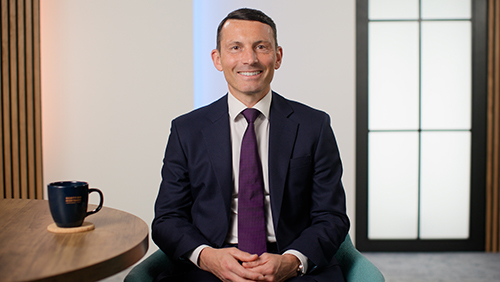
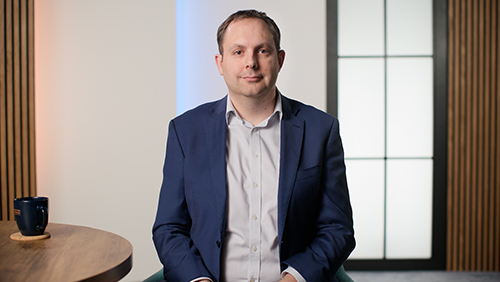
Yakir Gola (YG): Two-day shipping was the fastest way to get something delivered at the time when we launched Gopuff, but we thought that over time, consumers are going to want faster and faster delivery.
Tom Slater (TS): This is a tough business. It’s about getting the basket sizes right, operating really efficiently and caring about every last cent of cost.
YG: The way of the future is Gopuff is just going to show up to your doorstep, and you should be able to know what you want, when you want it, how you want it, delivered instantly.
Claire Shaw (CS): Hello and welcome to Invest in Progress, the Scottish Mortgage podcast. I’m Claire Shaw, portfolio director. In this podcast, we take you behind the scenes to hear conversations between our investment managers and leaders of the world’s most exceptional growth companies. As a UK investment trust, we can only market Scottish Mortgage to certain audiences and geographies, so check out the podcast description to ensure this episode is suitable for you. And, as with any investment, your capital is at risk.
You’re about to hear from Yakir Gola, the co-founder of the firm that packs, preps and delivers everyday items to households in less time than it takes to cook a bowl of pasta. Gopuff is a private company that provides super-fast shopping at supermarket prices. Goods arrive at your door in as little as 15 minutes, thanks to it running its own warehouses and logistics technology. It even lets you livestream your order getting packed. Gopuff has pioneered instant commerce, but it is no instant company.
It’s taken 12 years to build the business. And while Covid brought complications, the company is firmly in growth mode again. For context, Gopuff is one of our smaller holdings, but as you’ll hear, its ambition is huge. And what’s more, it can draw on the advice of Starbucks founder Howard Schultz, ex-Disney chief Bob Iger and Alibaba chair Joe Tsai, who are all connected to the business. So let’s hear from Scottish Mortgage manager Tom Slater and Yakir Gola.
TS: Hi Yakir, thank you for coming on the show. It’s fantastic to have you with us. We ask all our guests the same opening question. Can you explain what Gopuff does and what the problem is that the company is trying to solve?
YG: Thank you for having me today. Gopuff is the leading instant commerce platform. We provide 5,000 products delivered in as fast as 15 minutes, available 24/7. We have all of our inventory in our warehouses. Whether it’s grocery, household items, everyday essentials, we’ll deliver to you at the lowest prices available 24/7.
TS: And you do that in the US and here in the UK?
YG: US and the UK.
TS: Now, Gopuff had its origins in Philadelphia. You met co-founder Rafael Ilishayev, there at university, and launched the company when you were still students. But that wasn’t the start of your time in business. While still in school, you’d already generated millions of dollars in online sales for your family’s business. So can you tell us a bit about that and what it was that gave you a taste for entrepreneurship?
YG: So I grew up working with my dad in the family business. My dad had a jewellery business. And when I was really young, I worked with him and I told him, “Why don’t we try selling this jewellery online instead of just focusing on the in-store sales?” And when I was in high school, I built an online jewellery platform where we would actually take used jewellery, we would polish it, refine it and then we would resell it online.
I was running this family business throughout high school and then into college, learning a lot from my dad and working in the family business where you’re a small business owner. You have to play every role in the company, whether it’s focusing on your customers, focusing on getting the lowest prices, giving the best value to your customers, negotiating. A lot of things you learn when you’re in a small business setting and a small business owner. And so I think from a young age, I saw my dad work really hard, and the work ethic required to be an entrepreneur gave me a passion for starting Gopuff in college.
TS: And when you began your studies at Drexel University, it must have seemed like it would be a stepping stone to follow your father and his father before him into the jewellery trade. So what then led you and Rafael to create Gopuff instead? Where’s the origin of the business?
YG: So when Raf and I were in college together, we were roommates, and me, him and a few other friends lived in a house together, and I was the only one out of our friends with a car. And I was driving everyone to the local 7-Eleven on Drexel and Penn’s campus. And I said, “There has to be a better way to get stuff delivered.” I was sick of running errands for all my friends.
And we had the idea one night when it was our friend’s birthday, and I was running all these errands, and Raf and I were in the car together and said, “How is there not a company that would deliver convenience products?” And this was before delivery at all was popular. And we asked a few friends, and they told us, “It’s a terrible idea. No one’s going to use a delivery app. And people are just going to go to the store.”
And we asked some smart friends. But we thought about it the next day. I kept thinking about it and saw this as a big opportunity, especially because of the trends in ecommerce. Two-day shipping was the fastest way to get something delivered at the time when we launched Gopuff, but we thought that over time, consumers are going to want faster and faster delivery.
I remember sitting with my dad when I was still involved in the family business, and I told him that this is what we want to do. And he was a little upset because his view was I was going to take over the business and the online business was doing so well. But I printed out a piece of paper that showed him all the trends in ecommerce and where things are going. And he believed in me and was very supportive. So Raf and I bootstrapped the company.
We slept in the warehouses. We were the first delivery drivers. I’ve done myself over 5,000 deliveries in Philadelphia and then Boston, where we launched our second market and really actually built a business off expanding all free cash flow for the first few years.
TS: You were in that sort of situation, you’re physically making the deliveries yourself, getting customer calls routed to your personal phones, sleeping in the warehouses. I mean, that must have been intense. And all this was some distance from Silicon Valley and below the radar of the venture capital funds. So how did you attract that first outside investment?
YG: Because of the way we grew up working with our families, and Raf also worked with his family, who are immigrants in the family business, we just had a discipline of you’ve got to make money in business. You really make sure you have the right value to the customer. And ultimately, our instinct was we needed to be vertically integrated.
So we needed to have our own warehouses so we can provide the lowest prices for consumers. That didn’t cross our mind to go any other way. And so, for us, we built a business by making money in the early days. And we convinced some suppliers to give us credit terms. We didn’t have the capital to support the buying inventory. And we got really creative.
And ultimately, we scaled the business. And it was one day, I think year three into the company, where we got a phone call from a venture capital firm in California. And someone in the warehouse, I was working there at the time, came up to me and said, “Hey, someone’s calling from this investment firm. They want to speak to you or Raf.”
So I was like, “OK, I’m happy to answer this call.” So I ended up speaking to them, and they ended up flying to Philadelphia and being very persistent and giving us capital because they were like, “You guys are profitable and you’re growing really fast, and all these college students are talking about you because all their interns at their firm were using Gopuff at the time.”
So that was the first time we raised capital, but our view was we’re going to stay focused on our customers and our business. We didn’t even know truly what Series A or venture capital was at the time. We were just building a business, using kind of first principles when we originally launched, and that’s how we scaled.
So we raised that first round of capital, and our view was we didn’t announce any fundraises. We were really under the radar. We just said we’re going to focus on our customers. That’s our North Star. That’s what we care about. But once we were able to raise the first round and we started to deploy a little bit of capital, the business just started doubling and tripling in a very short period of time. And the business started to really gain traction and started to really evolve.
TS: So let’s skip forward to 2021, when Scottish Mortgage first invested in Gopuff. I think one of the compelling data points for us was that the number of 7-Eleven stores in Philadelphia, where you first started, had dropped by more than a third since you’d launched. Meantime, you broadened your range to include frozen goods like ice-cream, as well as beer and nappies, widening that appeal.
And we already had a holding in another fast delivery service, DoorDash. But what made Gopuff distinct was your reliance on your own inventory, warehouses rather than dispatching shoppers to pick up items from third-party stores. So why did you pursue that route rather than the more asset-light approach of instant commerce that rivals such as Instacart or Uber Eats or indeed DoorDash?
YG: Our original instinct was it’s all about the customer, and we wanted to provide the best value and the best prices for our customers. And so our instinct was if we went the third-party route, whether it’s going to stores and charging markups and service fees, it would become really expensive for the customer. It wouldn’t be enough value from a profitability perspective.
And growing up in the family business, we realised how important it is to offer the best prices to customers and the best value. And what we learned over time is by being vertically integrated and having our own warehouses, it led to a lot of benefits, such as having near-100 percent order accuracy versus when you order from third-party services that just are middlemen, essentially. Not only is it on average 30 percent more expensive than Gopuff, but in fact there’s roughly between 25 and 30 percent of the time there’s issues with your order due to lack of inventory integration and full control of the customer experience. So at the time it was really the instincts and how we grew up working in the family business and our view around it’s all about the customer.
TS: And one of my colleagues who visited one of those facilities shortly before we invested came back describing Gopuff as the king of the night. You received the bulk of your orders between 6pm and 2am. Is that still the case?
YG: We have a really big late-night business, so I would say it’s very much the case that a lot of our volume is after noon and after 5pm. But I would say over time, due to the expansion into things like grocery or Starbucks, a lot of the growth during the daytime and in the morning has grown pretty considerably. But I would say we’re still pretty much the kings of late night. And it’s a lot of times people use Gopuff the most when the stores are closed and you have an important day the next day and Gopuff’s there to deliver 24/7.
TS: Now, today you operate in the US and the UK. Your customers can choose between a flat delivery fee per order or a monthly FAM membership. And that covers as many drop-offs as they want and access to special deals. As a long-term shareholder in Amazon, we’ve seen how Prime subscription helped drive repeat business. How critical is your FAM subscription base to your business?
YG: For us, the FAM membership is really important. We’ve really prioritised it over the last five years. A little over 60 percent of our orders are now coming through our membership. So people pay $8 a month, and they get, like you said, unlimited free delivery. We have something that we call Cheapest on the Planet. So you can get things like $2 organic eggs, if you’re a member, or hundreds of other great deals. And what we see on average is our FAM members purchase 50 percent more than our non-FAM members on a monthly basis. So once people try Gopuff, they like the experience, they then a lot of times sign up to the membership, and it becomes part of their everyday life.
TS: Another growing part of your business is Americans enrolled in the Supplemental Nutrition Assistance Program, what some in our audience may know better as food stamps. The scheme provides financial assistance to people on low or no income to buy healthy food. You started accepting SNAP payments just over a year ago and offer free delivery to qualifying customers who spend $35 or more without requiring that FAM membership. That sounds quite a different picture from your traditional customer. So how does that group fit into the picture?
YG: Over building the business, we started to get a lot of requests and demand from those that are on the food stamps programme to be able to purchase and use Gopuff with their food stamps. And what we realised is because we’re really focused on value and giving value to the customer, we saw that a lot of the other options for ecommerce that offer SNAP have become really expensive because the markups of the prices and then the massive service fees on top.
But if you’re on food stamps today, you actually can’t cover any of the delivery fees or significant markups with your food stamps. And so we thought if we’re able to get this licence, we’re able to offer everyday Americans that are in need of this SNAP assistance programme, we’re able to bring them the lowest prices with no additional fees. And so we worked with the government for over three years, we were able to get this approval, and now it’s growing kind of very rapidly. And we’re able to offer groceries to those in food deserts that don’t have access actually to stores nearby. And we’re able to offer instant delivery at the same prices as in store using your food stamps today.
So we worked with the government, we’re able to get this approval, and it’s actually a fast-growing part of our business today.
TS: It’s a great example of businesses contributing to society more broadly. Just talk us through the programme that Gopuff introduced when the food stamp programme suffered a hiatus at the end of last year.
YG: The government was shut down at the time. There were a lot of talks around there being a complete halt to the SNAP assistance programme in the US and those that rely on food stamps every month. We were kind of in crisis mode because the government shut down, and there was a mandate to stop all the SNAP funding. And so we sat as a leadership team and said, Gopuff is all about being there for communities in times of need. And it’s part of our culture. It’s part of the DNA.
And so what we put up is, and we were the first company to do this, is we offered $10m to those that are on food stamps, free and clear. There’s no asterisks or you have to spend a certain amount of money. No, we offered it to those that need to qualify for the food assistance programme, and we saw within a week over 100,000 people signed up to Gopuff. And we offered it to them, and people were very, very happy. We got tons of emails and messages of how we were there for them in time of need. And I think people were very happy with that. And we thought it was the right thing to do.
TS: I mean, it’s just a great example of that customer focus that you have, but it also being good for the business. As you say, it brought lots of new people into Gopuff because you were prepared to be there and support that community at a time when there was real pressure on it. You’ve talked about wanting Gopuff to be a place where people go to shop for their daily essentials, so not just treats, impulse buys. How far along that journey are you today?
YG: We’re still in the early innings. I would say Gopuff for the first five years is very much convenience driven. And over the last five, six years, we’ve really evolved into becoming this everyday essentials platform. And our view is we’re not trying to be everything to everyone, but we want to cover all major use cases for grocery.
Think, let’s use an example, if you want peanut butter, or if you want avocados, or bananas, or milk and eggs, we’re going to cover all those use cases. Now, we maybe won’t have the same level of assortment that you might find in a very large supermarket, but we’ll cover the organic options, the lowest cost options, and we’ll have many different options for those that want these major use cases within grocery.
So what I tell people is you can live off of Gopuff. You have all your fresh produce, you have all of your dairy products, your meat essentials and obviously convenience, which is the foundation of the company and how we build. We cover whether you want snacks, you want ice-cream, you want medicine, you want household items, so the mandate for us has been, how do we evolve into this everyday essentials platform?
And actually, we had an internal initiative of how do we evolve from late night to everyday essentials. And I would say we’re still in the early innings, but customers love the new fresh grocery assortment. And it’s actually only available in 30 percent of our markets. But in those markets where we have our fresh grocery assortment, we’re seeing nearly two times the growth rate in our markets that don’t. So we believe in quality.
So we only launch our fresh grocery assortment when we’re ready for it in a market. And so far, we’re getting a lot of feedback from customers. We’re improving the assortment, the quality is improving, and we’re really excited about the growth there. But I would tell you we’re still in the early innings of that transition, and the customers really love it so far.
TS: Now, another notable development has been a focus on strategic partnerships. The one with Starbucks has been fascinating. The coffee chain has trialled having its baristas use its equipment to make food and drink in your warehouses, from which you deliver them to customers at any time of day or night. How big do you think the potential is for developing these partnerships?
YG: For us, we’ve started to get a lot of inbound interest from companies where they see the impact that Gopuff’s having in consumers’ lives. And they understand that consumers are wanting things delivered faster and faster. And that’s becoming a part of their everyday life.
Although, I’ll tell you, online grocery today is still only at 13 percent penetration, meaning 87 percent is still offline in the stores, but it’s quickly transitioning to online. And that’s in the US. I think it’s probably a bit higher in the UK, but in the US.
TS: Yeah.
YG: And so the partnership with Starbucks is a good example where we did a pilot with them where in one of our markets, we offered Starbucks’ full assortment, whether it’s the iced coffees or the sandwiches or all the bakery products. We offered it in the Gopuff warehouse to all Gopuff users. And it was a massive success because it drove significant revenue. And those that bought Starbucks, 80 percent of their baskets also included non-Starbucks items.
And so the incremental value of being able to get Starbucks at the same price as the store has become great value for consumers. And also it’s available 24/7, whereas typical Starbucks is closed, maybe 5pm or 7pm. So the combination of the technology and the infrastructure that we’ve built has created these great opportunities to partner where it’s a win-win situation, where we’re driving significant volume for Starbucks, and it’s become a massive success given the pilot with them where we actually now have this available across many, many metros across the US.
And it’s scaling really nicely. And that’s a good example of a strategic partnership that we’re very excited about. There’s more that we’re doing, whether it’s with Robinhood or many other companies that we’re going to be announcing soon as well.
TS: You’ve also partnered with Amazon here in the UK to offer deliveries via its website. You’ve formed a small-scale partnership with DoorDash in the US too. That might surprise some, given it’s natural to describe them as competition. So can you tell us more about those arrangements and the logic behind them?
YG: I think it goes back to what I said a little bit earlier, where during the last four or five years, considering there’s been sort of a shift in the economy and capital markets, I think a lot of people had to take a step back and say, what are we the best at? And I think this is where a lot of people needed to focus on their core business.
For us, our core business is instant delivery and having our own warehouses, building technology and offering the best customer experience on the planet for instant delivery. I think that led to other partnerships. And so we have great relationships and great partnerships with some of the companies you mentioned, where if you’re on some of those platforms, you’re actually able to get the full Gopuff experience on those services. Gopuff, though, handles the delivery, it still comes from our warehouses, our driver network and the full Gopuff offering as well.
TS: And you don’t worry that there’s a risk that that could give them knowledge that they could use to replicate what you do? I guess what I’m asking is, how defensible is what you’ve built?
YG: Been doing this for 12 years. We’re always improving, always learning, always getting better and always innovating for our customer. But we strive to be the best in the world at instant delivery. Because this is our core business and this is all that we do, we’ve been able to not only provide the best value to the customer and the best assortment and the best quality experience, but also do it in a profitable way that has really strong margins and unit economics.
And that takes a lot of discipline, a lot of evolution of the technology. It takes the right basket sizes and the right articulation of trial and error and improvements, whether it’s having the right liquor licences or having the right grocery experience or having the right features to be able to build the big enough basket to make money and have the lowest cost to serve to consumers. So for us, we’re focused on the long term, and we’re focused on always innovating for our customer.
But because this is our core business, we say no to a lot of things. We don’t try to get into things as a pet project. And the culture of the company is if we innovate in something and we put our brand behind something, we want to be the best in the world at that. And so we remain really focused on Gopuff offering the fastest delivery, the best assortment, the best prices, the best reliability, and this is all that we do.
It’s the core business. So we think our customers love us. Hopefully more customers will love us and continue to spread the word on Gopuff and the magic of the Gopuff experience. And we just have to continue to stay hungry and to continue to innovate.
TS: I want to come back to culture. But you touched on this briefly when you talked about the changing market conditions, the changing capital markets. Not everything has gone your way, as of course we should expect. And after a surge in demand during the Covid pandemic, you had to scale back. And you pulled out of France and Spain. You reduced some of your growth projections. So what were the lessons that you learned from that more difficult period?
YG: I think the lessons that we learned was that it really just comes down to focusing on your customers. And I think there were instances in which we were operating maybe certain businesses or in certain markets where the customer experience wasn’t world class. And as a result, we decided to get rid of, I would say, shiny objects and get rid of things that we didn’t see either a path to real profitability, or we didn’t think we can be the best in the world at.
And so we came to our board at the end of 2021, after we raised capital, and said, “Hey, we want to focus the company on getting to profitability.” And we were profitable at a smaller scale. But considering we’ve grown significantly in terms of our footprint, in our scale, we wanted to turn the company back to a profitable state. At the time, we got a lot of heat on that, and we weren’t very popular. This was before the markets corrected.
And there was a lot of competition at the time in terms of instant commerce in the US and the UK. But we just said, “We’re going to stay focused on our customers. And we’re going to focus on the unit economics of the business. We’re going to get out of some unprofitable markets where we don’t see the path there. And we’re going to double down where we think we can be number one.”
And that’s what we did. And it was a great team effort. It was a lot of hard work, and we’re constantly improving the business, but I’m very proud of the progress and the team, of all the great work that we’ve been able to do, whether it is grow this membership programme from nothing into something really big, or it is building a massive private label business, or it is driving a lot of technology to bring our cost to deliver down to the lowest cost, we believe, in the industry for fast delivery.
And it’s really kind of cracking the code on the profitability of the model, which has been, I would say, very difficult and a lot of people have tried to do, but it takes a lot of discipline to provide the world-class customer experience with the right economics, right? You can charge customers $15 delivery fees and $20, but nobody’s going to come buy your product. So ultimately, how do you provide the best value with the best economics? And so bringing those two together, I think I’m very proud of the team. But we had setbacks in the past, and we were able to really make the business very, very strong today.
TS: And we participated in your 2025 funding round. One of the reasons we did is how you handled that post-Covid period and making the tough decisions to close underperforming fulfilment centres and to invest in fleet management and building the base of the business. Is the right way to think about that period that you were investing in the quality and sustainability of your proposition, even at the expense of short-term growth?
YG: Absolutely, yes. There’s a saying, you’d rather have less customers that love you than a lot of customers maybe kind of like you. And my view was similar to the Apple philosophy, where when Steve Jobs was giving other CEOs advice, his big thing was kill all the products that are shitty and remove all the products that you’re not doing a great job in.
And frankly, it’s very hard to do many things well. And I think Apple was very good at that. And at the time, Apple was a very small company. And you had, kind of, Microsoft and others that were much, much larger, but had a whole suite of products. And Apple said, “We’re just going to do less and be very focused.”
And that’s the mandate that we gave the team, is we’re going to do less, and we’re going to be very focused. And so that’s just where we leaned into things like our delivery times, our assortment, our out of stocks, providing more value to the customer, whether it’s the private label, or actually bringing our costs down for prices as well, passing on savings to the customer, making sure that we had the best products for consumers that people were searching for.
We were first on trends with all the major viral products that kind of came out. And so just that obsession over the customer, I think, allowed us to propel, to be very focused to achieve the results that we have today. And I would say we’re still in the early innings of our business. But we have great momentum now today.
TS: Yeah, and can you talk, drill in a little bit more on that? Is it fair to say that the focus has now swung back to focusing on product innovation and growth after that period?
YG: Yeah, I would say so. In the last 12 months, we’ve significantly reignited growth into the company. We’re driving really strong same-store sales growth. But I would say at the same time, we’re still very small from an overall penetration perspective. There are some markets where we’re doing significant volume, but when you actually look at the amount of people that are still using Gopuff in our most penetrated markets, it’s still very small, single-digit percentages.
But the equivalent of the volume we’re able to drive is probably 10 to 20 times what a typical retail store is in those markets. And so I think we’ve kind of flipped the model on its head. And now we’re really focused on growth and innovation more than ever before, due to the unlock of the unit economics of the business.
So, whether it is this partnership with Starbucks or this new AI product that we’re working on that we think will transform the way consumers are shopping using AI and saving them time and making it a truly magical experience using the latest technology. Or it’s just continuing to improve on the speed of the delivery, on the quality of the assortment, like the fresh grocery expansion that we have today where we’re constantly introducing new items for consumers. But there’s a lot of exciting things now happening at the company that’s leading to a lot of innovation and growth.
TS: Now, we touched on culture earlier. We were actually first introduced to you via another portfolio company, Nuro, whose CEO described Gopuff as unafraid and aggressive. And you yourself, I think, have previously described the business as lean and scrappy. So to what extent are those still fair descriptions of Gopuff today?
YG: I would say it’s still fair. I think one of the things that we’ve done in this transformation of the company in the last four or five years is we removed all bureaucracy because at the time, when we were opening many locations at once, and we had this post-Covid era, we made some hiring mistakes and we learned from them.
But one of the things that we did was get back to the DNA of the culture of the company and how we built the business, which is rolling up our sleeves and getting in the details and having everyone be owners. And so one of the things we did was we gave everyone equity. Everyone that works in the company has equity, and everyone’s an owner. And we believe in that ownership mentality. And so what we’ve been able to do is bring that founders’ DNA imprinted into the entire organization, where you own the problem. Right?
So this is not something where I’m going to go set up a meeting, and then we’re going to go talk about it for weeks. And this is like, no, you’ve got to go fix it, and you’ve got to go get it done, and you own it. And that ownership mindset, that bias for action. And so I would say we’re still lean and scrappy, but we’ve improved significantly in how we operate the business, whether it’s using technology or actually AI to make smarter decisions and doing it in a very resourceful way.
But the DNA of the company is still very much no bureaucracy. We get things done. We have a bias for action. And we obsess over our customers. And nothing else matters but our customers. And that’s what we’re going to focus on.
TS: So you started Gopuff at 19. You’re now running a company that operates across two countries, thousands of employees. How would you say the Yakir of 2026 is different to the one who was sleeping two to three hours a night on the warehouse floor back then?
YG: It’s a good question. Both Raf and I, my business partner, both now married. He has two kids. I have one daughter, another one on the way.
TS: Congratulations.
YG: Thank you. Amazing wife. And what I would say is we’ve grown up with the business, and the business actually has evolved in a similar way and how we’ve grown up in terms of needing nappies for a newborn or getting, needing groceries delivered and having my wife or perhaps Raf’s wife complain about the assortment. And we need to be the best users of our product, and so one of the things we do is we want to Gopuff multiple times a day.
I think Raf is actually customer number one overall, and I’m probably like number 10 or something like that, and my wife is like 30. But we obsess over the product, but we’ve evolved the assortment from when we were 19 and college students to what we have today. And so I would say we’ve become more efficient. We’ve become better operators in the business. We hired better people. I think we learned from past mistakes, and that’s the thing about, I think, being good founders is learning quickly and not making the same mistake twice.
Being able to improve and iterate. And I think that the difference from where we were back then to now is we’ve learned a lot. We failed a lot, right? But the level of improvement I think today is significantly greater than the level of improvement and the speed of improvement which we were operating 10 years ago.
And some of that is also due to the kind of people we have around us, whether it’s people like Howard Schultz or Bob Iger or Joe Tsai who’ve been involved with the company formally. And we have really smart people around the table that have scaled massive companies. And we’re not afraid to ask questions and ask for feedback and see how we can do better. And we’re our biggest critic, and we’re never satisfied.
So we always want to improve. And we’re always looking for the negative feedback. And, actually, this is where I think Elon Musk does a great job is he doesn’t ask people for what’s going well, what’s not good about the product. That’s what I want to hear from you so we can improve. And even to this day, looking at App Store reviews and looking at the negative reviews.
And I’m not looking at the positives. I actually don’t look at the positives. I only look at the negatives. And I’m asking the team, why did we piss off this customer? Why did we fail this customer? And the bias for action and finding out the root cause and then fixing that problem. And so the level of improvement that we’re making in the business today is rapid. And I think that’s the thing I’m most excited about from where we were back then is the learnings over the years and the constant improvement and innovation.
TS: We always close with the same question. What does the world look like if Gopuff succeeds in its mission?
YG: For us, it’s about saving people time in the day. And I think today we’re delivering 20 to 30 minutes, we have great prices, we have a great experience, we’re available 24/7, but I tell our team that’s not good enough, and we have to continue to raise the bar for our customers.
And so ultimately we think that the way of the future is, Gopuff is just going to show up to your doorstep, and we should be able to know what you want, when you want it, how you want it, delivered instantly. And instead of it, delivering in 20, 30 minutes, it should be significantly faster than that. It should be significantly cheaper than that.
And we should be able to really take the hassle of shopping for everyday essentials and groceries out of your life, whether today, it’s a lot of times you’re still going to the store. And in a lot of markets, it’s just not a great experience. And you should be using your time to focus on other things, whether it’s your career, whether it’s your family and your relationships that you’re trying to build. Or it’s starting a business, right? Being an entrepreneur.
Or it’s actually a lot of times our best customers are the athletes, professional athletes. And a lot of times they’re travelling, and they’re using Gopuff all the time, organically. And they reach out to us and say, we want to do partnerships. So we recently just announced something with one of the top NBA players, Giannis, as well. And we have many, many others that are just using Gopuff all the time because they value their time.
Because they’re focused on what they’re building and being the best at what they’re doing. And I think that over time, that’s going to translate to just everyday consumers of using their time more efficiently. And if Gopuff could save you time while saving you money, we believe that will be an important part of consumers’ lives and will allow them to go focus on things that we think are more important to succeed in their life and their aspirations over time.
TS: There’s no greater gift than time. I wholeheartedly support that. Thank you so much for joining us. What you and Rafael have built out of that dorm room in Philadelphia is remarkable. We very much look forward to seeing what comes next. Thank you so much.
YG: Yeah, we have a long way to go. We appreciate it. Thank you for the time today.
CS: Tom, what a fascinating conversation. I love Yakir’s vision of a world where Gopuff just shows up at your doorstep with what you need before you even think about it. And I think your observation about the gift of time really captures something we all feel. So as always, this portion of the podcast is where we discuss the investment case from our perspective as investors.
So let’s start at the beginning. You mentioned that Scottish Mortgage first invested in Gopuff back in 2021. And one of the compelling data points was that 7-Eleven had closed more than 20 of its Philadelphia stores after Gopuff’s launch. So I’m interested, what was it that first drew you to the business, and how did it come on your radar?
TS: Well, I think at that time, if you go back to 2021, we were just coming out of Covid, people’s shopping habits had changed. We saw the opportunity for a very different model to serve what people wanted at that time. We actually met Gopuff management through a holding in Nuro, the robotic delivery service, or that was their main focus at that time. And so it was a warm introduction from them.
CS: Okay. And then picking up on something that really stood out in the conversation for me was the partnership at the top. Gopuff’s two co-founders share chief executive duties. And I think what really came through was the depth of the bond between Yakir and Rafael.
They grew up in these similar immigrant family businesses. They were in the trenches together from day one. They’re still neighbours today. It’s kind of a remarkable pairing. But from your perspective, what is it about the two of them, both I guess individually and together, that increases the company’s chances of success?
TS: Well, I think it’s pretty rare for an incumbent to take on a new category or a new way of operating. This is a tough business. It’s about getting the basket sizes right, operating really efficiently and caring about every last cent of cost. And I think that sort of entrepreneurial flair combined with that frugality in the way that they operate the business and the complementary strengths that they have is really key to the way that they’re getting on.
CS: And then I guess I thought Yakir’s answer to your question about the sort of defensibility was really telling. This is a space where, as you say, there’s no shortage of competition from Instacart to Uber Eats, and Yakir highlighted discipline, this importance of staying focused on Gopuff’s core business and the evolution of its in-house technology through years of trial and error. But in your mind, Tom, can you tell me what gives the business its competitive edge?
TS: Well, I almost would frame the competitive set differently. You talked about 7-Eleven, that such a small part of the convenience category is online. And so, yes, there are others going after it. But I think that you should think about the competition as the brick-and-mortar stores and servicing the need they service more effectively.
I think if you broaden that out to where competitive edges lie, I think alcohol licences are a really important part of that. Alcohol is a big category in convenience, and in the US there is such strict permitting rules around that. So the fact that they have this big set of permits across all these important markets is a really big barrier to other people running the service economically.
And then the final piece I’d touch on would be the FAM membership scheme. I think those members shop more, they shop more frequently, they spend more, they have loyalty, they don’t have to be reacquired. I think that subscriber base is a really important competitive edge.
CS: So Tom, we’ve heard many of the positives, but I guess we wouldn’t be doing our job as investors if we also didn’t consider some of the risks. And Gopuff is definitely, I would say, battle-hardened after its post-Covid experience, and it’s refocused the business. And I loved Yakir’s reference to Steve Jobs’s advice about killing the products that aren’t working. But looking ahead, I mean, what do you see as the most significant threats facing Gopuff? And how well placed do you think they are to overcome those threats?
TS: I think the broader retail environment is really important. What happens with interest rates, what happens with cost pressures, all the things that we know are important for a retail business. I think that’s a significant part of it. I think their continued success in driving costs down and basket sizes up, because I think if you can offer products at attractive price points, if people don’t feel like they’re paying a big premium for convenience, I think that is really important to consumers. And then I think you sort of talked about it a little bit in the last question, but it’s just execution. There’s just thousands of little things to get right to make a business like this work.
CS: And then, so maybe just a final question. One of the statistics that I guess really struck me was online grocery penetration in the US is still only something like 13 percent. So that means 87 percent of people are still physically going to stores. And even in Gopuff’s most penetrated markets, Yakir said fewer than one in 10 consumers use them. So this suggests there’s this enormous runway ahead for them.
So how do you think about that scale of the opportunity, both in terms of growing the customer base, but also building on the partnerships like Starbucks, the one we heard about from Yakir?
TS: With its current footprint, Gopuff only serves 30 percent of the US population. And they’ve had millions of potential customers sign up only to find that they’re not within the delivery areas of Gopuff. So I think there’s just this huge amount of white space for them to roll out the service.
Then I think it’s, as you say, as you bring brands onto the platform, that’s a really compelling way to get new users. The fact that outside of store hours, Gopuff is the place to get Starbucks is a really useful validation. And as they build out more of these partnerships, it makes the user bases of those products more accessible to them.
I think at the same time, it goes back to what we talked about in the last question, which is your prices have got to be compelling. Consumers are incredibly price sensitive. And so if you can match the prices that they will experience elsewhere outside of the convenience category or get closer and closer to those price points, then I think that just brings more and more users to them.
CS: So I think that’s a really good note to end on. Thank you, Tom, for all your analysis, as always. And a big thank you to our guest, Yakir Gola, the co-CEO of Gopuff, for such a revealing and fascinating conversation.
A couple of quick things to mention. We’re releasing 10-Minute Take cutdowns of each of this season’s podcasts to give you the option of catching up when time is tight. And we’ve explained any jargon that cropped up in the show notes. If you haven’t already, please do subscribe so you’re the first to hear new episodes. And you can learn more about Scottish Mortgage by visiting our website at scottishmortgage.com. You’ve been listening to Invest in Progress. Thank you for joining us.